

Walter Jacob
Altenburg/Thüringen
1893 -
Hindelang/Allgäu
1964
Walter Jacob, who belongs to the second generation of German Expressionists, was the son of Richard Jacob, a decoration painter. Walter Jacob started painting and drawing at an early age. After breaking off two apprenticeships, he embarked in 1910 on an apprenticeship as a decoration painter in Meerane, where he met Ernst Müller-Gräfe, a pupil of Kuehl's who would thenceforth play an important role in Walter Jacob's development as an artist. He worked at night on drawings and studies, which he sent regularly between 1910-13 to Müller-Gräfe in Dresden to receive his criticisms of them.
A strong urge to become an artist and flee the idustrial city of Meerane finally led Walter Jacob to break off his apprenticeship. A bitter fight for economic survival began, which could often only be achieved by accepting unpleasant commissions and odd jobs. He suffered from such chronic poverty that he could hardly afford paints, which is why he produced mainly drawings.
In 1914 he took part in his first group show, at the Bayer & Sohn gallery in Leipzig. Volunteering for national service, he spent the years 1914-18 at the front, with the interruption of a long period of convalescence from a wound in 1915-16.
During that time Jacob enrolled as a student at the Dresden Academy and was already in contact with Robert Sterl, whose master class he attended in 1919-20. In his work, he comes to terms with the horrors of his wartime experiences. He showed work at several exhibitions in Dresden.
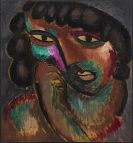
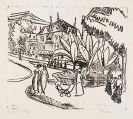
After the war Jacob preferred to work with woodcuts and was close to the "Dresdner Secession Group 1919" as well as Kokoschka and Dix. In 1920 he turned to painting expressively in oils in intense colours, dealing with such subjects as war, the Passion and city life. After spending quite some time in Berlin, he left the metropolis, travelling to view art and seeking solitude on the North Sea island of Hallig Hooge, in Upper Bavaria, the Lausitz, Switzerland, Austria and Yugoslavia until 1928.
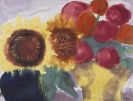
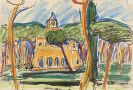
The years that followed, which Walter Jacob spent primarily in Munich and Dachau until 1945, were marred by poverty, depressive phases and contradictions in his life and work. After the second world war, the artist lived at Hindelang in the Allgäu, working on dramatically stirring scenes, often biblical in content, in which he reflects on the past. He also did some abstract landscapes in a vibrant palette.
In 1956 Jacob had his most important retrospective, comprising more than two hundred works, at the Galerie André Maurice in Paris, which sums up his œuvre.
![Otto Mueller - Zwei Zigeunermädchen im Wohnraum [historischer Titel]](https://www.kettererkunst.de/still/kunst/picm/22/125000258.jpg)

Would you like to sell a work by Walter Jacob?
Infos for seller


Starting bid: 4,500 EUR